
Water extraction and cleanup on Long Island
Truck-mounted extraction pulls standing water out in the first hour, before it wicks into drywall, subfloor and framing. Then we dry the structure to the studs and document every reading for your carrier.
- Truck-mounted and portable extraction for every access situation
- Moisture mapping and thermal imaging before we touch anything
- LGR dehumidifiers and balanced airflow, monitored daily
- Written moisture logs your adjuster will accept
24/7 Emergency Intake
Tell us what happened
Send the details and we'll call you straight back. If water is moving right now, calling is faster.
Active emergency? 516-905-5970
Getting the water out is only the first half
Water extraction is the removal of standing and absorbed water from a structure using mechanical suction — truck-mounted vacuum systems, portable extractors and submersible pumps. It is the first phase of any water damage job, and it is the phase that decides what the rest of the job costs.
The distinction that matters: extraction removes bulk water, drying removes bound water. A wet-vac can take the puddle off a tile floor. It cannot pull the moisture out of a carpet pad, out of the bottom four inches of drywall, or out of a plywood subfloor that has been sitting in half an inch of water for six hours. That water is held inside the material, and only pressure-differential extraction followed by controlled dehumidification will move it.
This is why the do-it-yourself version so often ends in a mold call three weeks later. For the sequence to follow before we arrive, see what to do in the first hour of a leak. The floor looked dry. The wall cavity was not.
Every job we run starts the same way: find the source, map the moisture, extract the bulk water, then set drying equipment sized to the actual load rather than to whatever fits in the van.
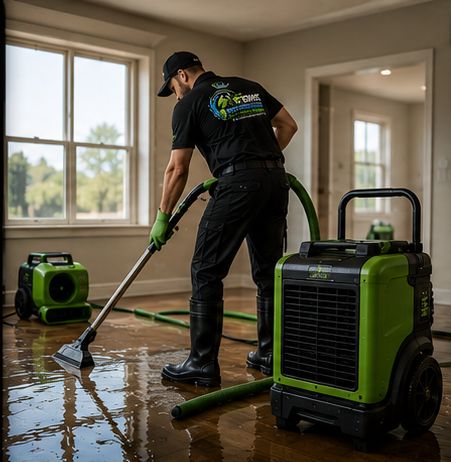
What water does to a house, hour by hour
Nothing about this timeline is dramatic. It is simply how porous building materials behave when they meet water, and it is why an hour of delay shows up on the final invoice.
0–1 hour
Water spreads laterally and finds every low point. Carpet and pad saturate. It wicks up drywall by capillary action and runs along the top plate into cavities you cannot see.
1–24 hours
Furniture finish bleeds into carpet. Particleboard and MDF swell and lose structure permanently. Drywall paper softens. Category 1 clean water begins degrading toward category 2.
24–48 hours
Mold can begin colonising on cellulose surfaces. Hardwood cups and crowns. Metal fasteners and hardware start corroding. Odour becomes noticeable.
48 hours and beyond
Mold growth becomes visible and the job changes category. Structural swelling and warping set. Materials that could have been dried in place now have to come out and go back in.
The practical version: the same loss that costs $1,200 at hour two can cost $9,000 at hour sixty. Not because prices change — because the scope does.
How we run an extraction
The same sequence on every job, whether it's a Levittown slab or a Cold Spring Harbor cellar. The order is not arbitrary — each step depends on the one before it.
Make the site safe and stop the source
Power to affected circuits goes off before anyone steps into standing water. If the source is still running we shut the supply, cap the line or arrange emergency plumbing. Extraction on an active leak is wasted effort.
Map the moisture before we move anything
Penetrating and non-penetrating meters plus thermal imaging establish where the water actually travelled — which is almost never where it is visible. We mark wet boundaries on the walls in pencil and record baseline readings, including a dry-standard reading from an unaffected area of the same material for comparison.
Document the loss for your carrier
Photographs and video before anything is disturbed, a written scope, and the moisture map. This is the evidence that decides whether the claim is approved. It cannot be recreated after the water is gone.
Extract bulk water
Submersible pumps for anything over a couple of inches, then truck-mounted or portable extraction across the affected surfaces. Carpet gets weighted-head extraction, repeated in overlapping passes until recovery drops off — usually far more passes than people expect.
Release trapped water
Water inside a wall cavity will not come out through the drywall face. We drill weep holes at the base plate, remove the base moulding, or make controlled flood cuts where saturation is above the line at which drywall can be saved. Cavity drying systems push air behind the wall rather than at it.
Set drying equipment to the actual load
Air movers positioned to create a vortex across wet surfaces, and LGR dehumidifiers sized to the cubic footage and the class of loss. Too little equipment leaves bound water behind. Too much drives up the bill without drying faster.
Monitor daily until readings hit dry standard
Every day we record temperature, relative humidity, grains per pound and material moisture content, and reposition equipment as the load drops. Equipment comes out when the affected materials match the dry standard — not when the calendar says three days.
Final documentation and handover
You receive the complete moisture log, before and after photographs and the final scope. If the job needs rebuild — drywall, flooring, paint — we carry straight through rather than handing you to another contractor.
The equipment, and what each piece is actually for
Restoration companies all list the same hardware. Here is what each one does and when it is the wrong choice — which is more useful than a specification sheet.
Truck-mounted extraction
Highest lift and continuous recovery, with waste going to an onboard tank rather than a bucket. First choice whenever we can reach the loss with hose. Limited by hose run and by properties where the truck cannot get close.
Portable extractors
Carried to upper floors, apartments over garages and Fire Island properties with no vehicle access. Lower recovery rate than a truck mount, so passes take longer — but they reach places the truck never will.
Submersible pumps
For standing water deeper than roughly two inches. Fast bulk removal, but they stop being useful once the water drops below the intake — which is where extraction takes over.
Air movers
Not fans for comfort. They break the boundary layer of saturated air sitting against a wet surface so evaporation can continue. Positioned at a low angle along walls to create circulation, not aimed head-on.
LGR dehumidifiers
Low-grain refrigerant units pull moisture out of the air the movers released. Without them, air movers simply relocate humidity to another part of the house. This pairing is the whole of structural drying.
Moisture meters and thermal imaging
Pin meters read moisture content inside a material; pinless meters scan without damage; thermal cameras show temperature differentials that indicate evaporative cooling. Together they find water behind finishes, and they tell us when to stop.
Extraction on Long Island is not extraction anywhere else
The Island's geology splits cleanly, and which side of it your house sits on changes how a water loss behaves and how we approach it.
North Shore — glacial till
The Harbor Hill moraine gives the North Shore hills, dense till and deep full basements. Water arrives through foundation cracks under hydrostatic pressure and collects at the lowest point. Basements are deeper, so volumes are larger, but the soil drains poorly and re-entry is common until the exterior grading issue is addressed.
South Shore — outwash plain
Flat, sandy outwash with the water table close to the surface. Foundations are shallower and slabs are common, so losses spread horizontally across a large footprint rather than collecting in one deep space. Extraction is wide rather than deep, and the high water table means pumping to grade can simply feed water back toward the house.
Suffolk cesspools
Much of Suffolk still runs on cesspools and septic rather than municipal sewer. That changes the category of a backup loss entirely — what would be a gray-water job on a sewered Nassau street is frequently category 3 in central and eastern Suffolk, with different containment, different disposal and different materials coming out.
Two more local factors worth knowing. Coastal storm surge along the South Shore and the barrier islands brings brackish water, which leaves salt behind after drying and continues to attract moisture unless the surfaces are cleaned rather than merely dried. And on the East End, seasonal properties sitting empty from November to May mean a burst supply line can run for weeks before anyone opens the door — those are rarely extraction jobs by the time we arrive. They are demolition and rebuild.
What can be saved, and what cannot
Homeowners are usually told either "we can save everything" or "it all has to come out." Neither is true. What survives depends on the material, the category of water and how long it sat.
Usually dried in place: hardwood if we reach it early and use mat systems, structural framing, plywood subfloor, concrete, tile, and drywall that is wet only at the base and only from clean water.
Usually removed: carpet pad in almost every case, particleboard and MDF furniture and cabinetry, insulation of any kind once saturated, and any porous material touched by category 3 water regardless of how briefly.
It depends: carpet itself can often be saved from clean water if the pad is replaced and it is extracted within the first day. Laminate flooring almost never survives. Engineered wood is a coin toss decided by the core.
We tell you which category each material falls into before we cut anything, and the reasoning goes in the written scope.
What extraction costs here
| Single room, clean water, extract and dry | $500 – $1,500 |
| Multiple rooms, one level | $1,500 – $4,000 |
| Flooded basement, extraction and dry-down | $2,000 – $6,000 |
| Multi-level loss with cavity drying | $5,000 – $12,000+ |
| Category 3 extraction with material removal | $4,000 – $10,000+ |
The variables are volume, the category of the water, how long it sat, and how much material has to be removed and replaced. On a covered claim your out-of-pocket is usually just the deductible — we bill your carrier directly. Every job gets a written estimate before work starts.
Get a written estimate — 516-905-5970Water extraction questions, answered
Can I just use a wet vac and skip the extraction?
A wet vac will remove surface water from hard flooring, and doing that before we arrive genuinely helps. What it cannot do is pull bound water out of carpet pad, drywall or subfloor, because that requires sustained pressure differential rather than suction at the surface. Most of the mold calls we take three weeks after a loss are homes where the floor looked dry and the wall cavity was not.
How many days will the drying equipment stay in my house?
Typically three to five days. We take moisture readings daily and remove equipment when the affected materials reach the dry standard measured from an unaffected area of the same material, not when a set number of days has passed. A small clean-water loss can finish in two days; a saturated basement with cavity drying can run a week or more.
Do you have to cut my walls?
Not always. If the drywall is wet only at the base and the water was clean, we can often dry it in place by removing the base moulding and drilling weep holes behind it, which is invisible once the moulding goes back. Flood cuts become necessary when saturation runs higher than roughly two feet, when insulation behind the wall is wet, or when the water was category 3. We show you the moisture readings that drive the decision before anything is cut.
Why do you need to run equipment overnight?
Evaporation is continuous. Shutting air movers and dehumidifiers off overnight lets moisture redistribute from wet materials back into the air and into dry areas, which undoes part of the previous day's progress and extends the job. The equipment is designed to run continuously and the electricity cost is generally a few dollars a day per unit.
My basement floods every heavy rain. Is extraction enough?
Extraction handles the water that is there now, but recurring intrusion is a drainage problem rather than a restoration problem, and it is common across Long Island because of the high water table. We will dry the space and tell you plainly what we observed — grading, gutter discharge, foundation cracks, sump capacity — so you can address the cause. Drying the same basement four times a year is not a service we want to sell you.
Is the water from a storm surge treated differently?
Yes. Storm surge and ground flooding are category 3 by definition, so porous materials that were touched are removed rather than dried. Coastal surge also carries salt, which remains in the material after the water evaporates and keeps attracting humidity, so affected surfaces are cleaned and treated rather than simply dried.
What usually comes next
Structural Drying
The phase that follows extraction — air movers, LGR dehumidifiers and daily moisture monitoring to dry standard.
Drying →Flooded Basement
Below-grade extraction where the Island's high water table and sump failures put the water in the first place.
Basements →Mold Prevention & Remediation
When water sat past the 24–48 hour window, containment and treatment before the space is returned.
Mold →Insurance Claim Support
The moisture logs, photographs and written scope that decide whether your claim is approved.
Claims →Serving Nassau and Suffolk
Dispatching from 30 Lynch St in Huntington Station. Response times are honest by zone — 45 to 60 minutes across the core townships, longer as you head east.
Standing water? Call now.
Every hour the water sits, the scope grows. Reach a real person any hour of any day.
- 24/7 emergency line516-905-5970
- Service address30 Lynch St, Huntington Station, NY 11746
- HoursOpen 24 hours — every day of the year
- Why usCertified & experienced · Fast response · Local, trusted, Long Island proud