
Fire and smoke damage restoration on Long Island
The fire is usually the smaller half of the loss. Soot keeps corroding, odour keeps migrating, and thousands of gallons of firefighting water are sitting in your floors — all of it starting the moment the trucks leave.
- Emergency board-up, tarping and securing before anything else
- Soot identified by type, because each one cleans differently
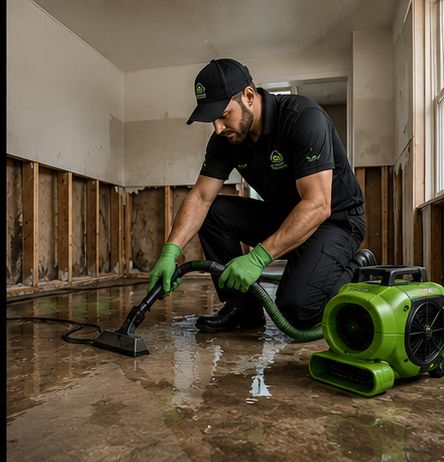
- Firefighting water extracted and the structure dried
- Odour treated at the source, not masked
24/7 Emergency Intake
Tell us what happened
Send the details and we'll call you straight back. If water is moving right now, calling is faster.
Active emergency? 516-905-5970
Three separate losses, arriving at once
People think of a fire as one event. Restoring it means dealing with three, and two of them are still actively getting worse while you stand in the driveway.
The burn itself is the most visible and often the smallest. It is confined to where the fire actually reached, and it is straightforward to scope.
Soot and smoke residue travelled everywhere the air went — through doorways, up stairwells, into closets, through the return ducts and out of every supply register in the building. Soot is acidic. Left on metal it pits and corrodes. Left on plastics and finishes it etches permanently, sometimes within days. This is why speed matters on a fire loss in a way people do not expect.
Firefighting water is the one nobody plans for. A working fire can take thousands of gallons, and all of it is now in your floors, your ceilings below and your wall cavities — with the same 24-to-48-hour mold clock as any other water loss, in a building that may have no power and no roof.
We handle all three, in the right order, so the second and third stop getting worse while the first is still being assessed.
Four residues, four completely different methods
Using the wrong technique does not merely fail — it drives residue into the surface and makes the damage permanent. Identifying the type is the first thing we do.
Dry smoke
Fast-burning, high-temperature fires. Powdery, dry, sits loose on surfaces. Cleans relatively well with dry sponges and HEPA vacuuming — but wiping it with anything damp smears it into the finish and sets it.
Wet smoke
Slow, smouldering, low-heat fires — often plastics and rubber. Sticky, dense, heavily smeared, with a strong lasting odour. Labour-intensive, and the residue frequently penetrates deep enough that surfaces cannot be fully recovered.
Protein residue
Kitchen fires, usually a forgotten pan. Nearly invisible — a thin amber film — but it discolours paint and varnish and the odour is extreme and persistent. People often clean the visible mess and cannot work out why the smell will not leave.
Fuel oil soot
A puffback from an oil-fired burner. Fine, oily black particulate distributed through the entire house by the heating system. Long Island sees a great deal of this, and it is covered in detail below.
Puffbacks: the oil-heat problem
A large share of older Long Island homes still run oil-fired boilers and furnaces, and that gives us a category of call most of the country rarely sees.
A puffback happens when unburned oil accumulates in the combustion chamber and then ignites all at once on the next start cycle. The resulting pressure pulse pushes fine, oily soot out of the unit and — if it is a forced-air system — straight through the ductwork into every room in the house. Homeowners describe walking in to find black film on the ceilings, on curtains, on the inside of kitchen cabinets, on the television screen, in rooms nowhere near the boiler.
Two things make puffback soot particularly difficult. It is oil-based, so it does not respond to ordinary household cleaning — it smears and spreads. And it is extremely fine, so it settles into fabric, carpet, HVAC components and every horizontal surface including the tops of door frames people never think to check.
Cleaning has to run top-down, room by room, with dry methods before wet ones, and the duct system needs cleaning or the next heating cycle redistributes everything you just paid to remove. Cleaning the rooms and skipping the ducts is the most common and most expensive mistake on these jobs.
Puffbacks are typically covered as sudden and accidental damage — but have a heating technician service the unit before you restart it, or you will be doing this twice.
How a fire loss is restored
Secure the structure
Emergency board-up of openings, tarping of roof damage and fencing where needed. An open building takes weather, animals and theft, and insurers expect reasonable steps to prevent further loss.
Extract firefighting water and start drying
Before soot work, because the mold clock is already running. Where there is no power we bring generators. Where the roof is open we dry under temporary cover.
Document everything, including contents
Photographs and a written inventory. Fire claims involve contents to a degree water claims usually do not, and an itemised record is what makes that part of the settlement work.
Identify the residue and remove the unsalvageable
Residue type determines method. Materials too damaged to clean come out first so they stop off-gassing odour into everything around them.
Clean from the top down, dry before wet
Ceilings, then walls, then contents, then floors. HEPA vacuuming and dry chemical sponges first; wet cleaning only where the residue type calls for it and only after dry methods have lifted what they can.
Clean the HVAC system
Ductwork holds soot and will redistribute it the moment the system runs. On a puffback this is not optional — it is the whole job.
Neutralise odour at the source
Thermal fogging, hydroxyl or ozone treatment depending on the situation, and sealing of substrates that have absorbed odour and cannot be replaced. Masking agents are not odour removal and we do not use them.
Rebuild
Drywall, flooring, trim, cabinetry and paint, carried straight through from mitigation so you are not managing a second contractor while living somewhere else.
What survives a fire
Usually cleanable: hard surfaces, most furniture with solid wood or metal frames, dishes and cookware, jewellery and metal objects once the acid residue is neutralised, and clothing through specialist textile restoration.
Usually not: anything charred, mattresses and pillows, food including sealed packaging and anything from a refrigerator that lost power, cosmetics and medicines, and most electronics that were running when soot reached them.
The judgement calls: upholstered furniture depends on residue type — dry smoke is often recoverable, wet smoke and protein residue rarely. Photographs and documents can frequently be saved by specialists even when they look destroyed, and they are usually the things people care about most.
One thing worth knowing: your policy almost certainly covers additional living expenses while the home is uninhabitable. Keep every receipt from the first night onward — hotel, meals, laundry, pet boarding.
What fire restoration costs here
| Puffback cleanup, average home with ducts | $3,000 – $10,000 |
| Contained kitchen fire, smoke through the house | $5,000 – $20,000 |
| Single-room fire with structural damage | $15,000 – $50,000 |
| Multi-room fire with rebuild | $50,000 – $150,000+ |
| Emergency board-up and tarping | $500 – $3,000 |
Fire losses vary more than any other job type because the range runs from a soot cleanup to a substantial reconstruction. Nearly all of them are covered — fire is the core peril every homeowners policy was written for — so the practical question is usually scope and settlement rather than whether you are covered at all.
Get a written estimate — 516-905-5970Questions, answered
The fire was small. Why is there damage in rooms it never reached?
Because smoke travels wherever air travels, and it does so in seconds. It moves through doorways, up stairwells, through gaps around fixtures and — if the system was running — through the return ducts and out of every supply register in the building. Soot also migrates toward cooler surfaces, which is why it often shows up worst on exterior walls and in closets far from the fire.
Can I clean the soot myself?
For a very small, contained incident on hard surfaces, carefully. The risk is that most soot types are made permanent by the wrong method — wiping dry smoke with a damp cloth smears it into the finish and sets it, and household cleaners on oily puffback residue spread it across a wider area. If you try anything, start in an inconspicuous corner. And do not run the HVAC, because that distributes what is currently sitting still.
Why does the smell keep coming back after everything looks clean?
Odour molecules are absorbed into porous materials — drywall, insulation, framing, carpet backing, upholstery — and they release slowly for months, especially when humidity rises. Surface cleaning removes what you can see and leaves what you can smell. Proper odour work means removing unsalvageable absorbent materials, treating the remainder at the source with thermal fogging or hydroxyl, and sealing substrates that cannot be replaced.
Is a puffback covered by my insurance?
Usually yes, as sudden and accidental damage, and it is one of the more commonly approved claims we see on Long Island. Where it gets contested is if the insurer determines the boiler was neglected — no service records, a known problem left unaddressed. Keep your annual service records. Have the unit serviced before you restart it after a puffback, or you risk a second event that is much harder to claim.
How long will I be out of my house?
A puffback cleanup is typically three to seven days and you can often stay if the affected areas can be sealed. A contained room fire with smoke through the house is usually two to four weeks. Anything involving structural rebuild runs two to six months. Your policy almost certainly covers additional living expenses for that period — start keeping receipts from the first night.
Should I let the insurance company's preferred contractor handle it?
You are entitled to choose your own contractor in New York; a preferred vendor is a recommendation, not a requirement. Preferred programmes can be genuinely convenient. The thing to understand is that those contractors have an ongoing commercial relationship with the carrier, which can create pressure toward a tighter scope. Get your own written scope either way — even if you go with theirs, having a second one costs you nothing and changes the conversation.
What connects to a fire loss
Structural Drying
Firefighting water is a full water loss on its own, with the same 24 to 48 hour mold clock.
Drying →Storm & Flood Damage
Emergency board-up and tarping to secure an open structure against weather.
Storm damage →Mold Prevention & Remediation
What follows if firefighting water sits in a building with no power and no roof.
Mold →Insurance Claim Support
Fire claims involve contents inventories that water claims usually do not.
Claims →Serving Nassau and Suffolk
Dispatching from 30 Lynch St in Huntington Station. Response times are honest by zone — 45 to 60 minutes across the core townships, longer as you head east.
Fire or smoke damage?
Soot keeps corroding and firefighting water keeps spreading from the moment the trucks pull away. The sooner we start, the more comes back.
- 24/7 emergency line516-905-5970
- Service address30 Lynch St, Huntington Station, NY 11746
- HoursOpen 24 hours — every day of the year
- Why usCertified & experienced · Fast response · Local, trusted, Long Island proud