
Flooded basement cleanup on Long Island
Sump failure, a nor’easter, a burst supply line or groundwater pushing up through the slab — we pump it out, dry the space properly, and tell you honestly why it happened.
- Submersible pumps and truck-mounted extraction for any depth
- Below-grade drying that accounts for the Island’s high water table
- Sanitising and antimicrobial treatment where the water warrants it
- A straight answer on whether it will happen again
24/7 Emergency Intake
Tell us what happened
Send the details and we'll call you straight back. If water is moving right now, calling is faster.
Active emergency? 516-905-5970
Long Island basements flood for reasons most of the country never deals with
We are a narrow glacial island sitting between the Atlantic and the Sound, and the groundwater underneath much of it is close to the surface. When heavy rain saturates the soil, the water table rises, and the pressure it exerts against a foundation — hydrostatic pressure — pushes water through hairline cracks, through the cold joint where the wall meets the footing, and up through the seams in a slab. No pipe has to fail. Nothing has to break.
That is why so many Island homeowners describe the same thing: no leak they can point to, no burst anything, and two inches of water across the floor after a storm that did not seem especially bad.
Layer on the housing stock. A large share of Nassau and central Suffolk was built out between the 1950s and the 1980s. Those homes are now running original galvanised supply lines, cast-iron waste lines at the end of their service life, and sump pumps that were installed decades ago and have never been tested under real load. A sump pump fails silently. You find out during the storm.
And the storm calendar barely closes. Hurricane remnants in late summer and autumn, then winter nor’easters that stall over the Island and push wind-driven rain and surge into below-grade space from Long Beach and the South Shore up to the harbours of the North Shore.
Six ways water gets into a Long Island basement
Each one leaves a different signature, and the signature tells us what has to happen next. We identify it before we start pumping, because the answer changes the job.
Hydrostatic pressure through the slab
Water appears at the floor–wall joint or seeps up through slab seams with no visible source above. Almost always groundwater. Common across the South Shore and anywhere the water table sits high.
Sump pump failure
The pit is full or overflowing and the pump is silent, running dry, or cycling without moving water. Failed float switch, seized impeller, or a power cut during the exact storm that needed it.
Foundation cracks and cold joints
A defined wet streak running down one section of wall, usually worse after prolonged rain. Structural rather than restoration — we dry it, then tell you what needs sealing from outside.
Burst or failed supply line
Clean water, often warm, arriving fast and unrelated to weather. Washing machine hoses, water heaters and old galvanised risers are the usual three.
Sewer or cesspool backup
Water rising from a floor drain, frequently with odour. This is category 3 and the whole approach changes — containment, protective equipment, removal of porous materials.
Storm surge and coastal flooding
Brackish water entering below grade during a nor’easter or tropical system. Category 3 by definition, and the salt left behind after drying keeps attracting moisture unless surfaces are cleaned.
If we cannot tell you which of these six it was, we have not finished the job.
How we clear a flooded basement
Below-grade work has one rule that surface work does not: you cannot pump a full basement dry as fast as you want to. Doing so can collapse a foundation wall.
Kill power before anyone goes down
Basements hold the panel, the boiler, the water heater and the laundry. Circuits serving the flooded area go off at the main before a foot touches the water. If the panel itself is submerged or the water is near it, we call the utility and nobody enters until it is de-energised.
Assess depth and check for structural risk
Where a basement is more than a couple of feet under, the water inside is partly holding the foundation walls against the saturated soil pressing in from outside. Pumping it out too quickly removes that counter-pressure and can bow or crack a wall. Deep floods come down in stages, roughly a third at a time, with the walls checked between stages.
Determine the category before choosing a discharge point
Clean groundwater can generally go to grade well away from the foundation. Category 3 water — sewage, cesspool backup, storm surge — cannot simply be pumped into the yard. That distinction gets made first, not after.
Pump the bulk, then extract the remainder
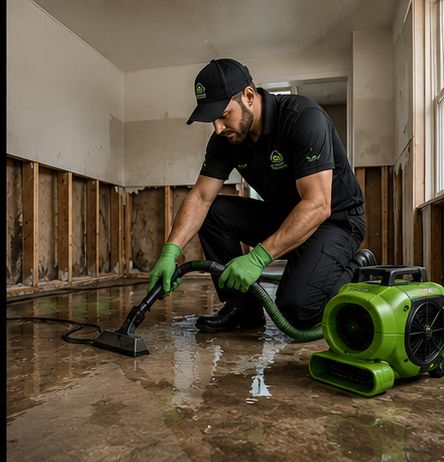
Submersibles clear standing depth. Once the water drops below the intake, truck-mounted or portable extraction takes over across the floor, and weighted extraction lifts water out of any carpet before the pad is pulled.
Remove what cannot be saved
Carpet pad, saturated insulation, particleboard shelving and any porous material touched by category 3 water comes out. Where drywall wicked above the salvage line, it is cut back to the nearest stud bay so the cavity can dry.
Dry the space as the closed system it is
A basement has almost no natural air exchange, so evaporated moisture has nowhere to go. Air movers plus LGR dehumidifiers sized to the volume, running continuously, with daily readings on the slab, the framing and the wall base.
Sanitise where the category calls for it
Antimicrobial application on affected surfaces after drying, not before — treating a wet surface simply dilutes the product. On surge losses we also clean rather than only dry, because the salt residue keeps pulling humidity back in.
Tell you why it happened
You get the moisture log, the photographs and a plain statement of what we observed: grading, gutter discharge, sump capacity, crack locations. If the fix is a drainage contractor rather than us, we say so.
What survives a flooded basement
Basements are full of the two categories of material that handle water worst: pressed wood and stored belongings. Being realistic early saves money and heartache.
Usually dried in place: concrete slab and block, structural framing, metal shelving, appliances that were never submerged above their base, and finished drywall wet only at the very bottom from clean water.
Almost always removed: carpet pad without exception, fibreglass and cellulose insulation, particleboard and MDF, cardboard storage, and anything porous touched by sewage or surge.
Depends on timing: carpet can survive clean water if extracted within the first day and the pad is replaced. Engineered and laminate flooring rarely survive below grade. Upholstered furniture that sat in category 1 water for a few hours can sometimes be cleaned; past that it is not worth the cost.
The category we care most about is the one nobody bills for — photographs, documents, keepsakes. Get those to dry ground before we arrive if it is safe to do so. Freezing wet photographs and paper genuinely buys time until they can be dried properly.
What a flooded basement costs here
| Under an inch, clean water, unfinished basement | $500 – $1,500 |
| Several inches, unfinished, pump and dry | $1,500 – $3,500 |
| Finished basement, extraction, flood cuts and drying | $3,000 – $8,000 |
| Deep flood requiring staged pump-down | $5,000 – $12,000+ |
| Sewage or surge backup with material removal | $4,000 – $10,000+ |
The single biggest cost driver below grade is whether the basement is finished. An unfinished basement is mostly a pumping and drying job. A finished basement means drywall, flooring, trim and often built-ins, and the rebuild is usually larger than the mitigation.
Read the coverage section carefully before you assume this is covered. Groundwater entering from below is excluded from standard homeowners policies and needs separate NFIP flood coverage. A failed sump pump is generally only covered if you carry a sump or water backup endorsement. A burst supply line usually is covered.
Get a written estimate — 516-905-5970Questions, answered
Why can't you just pump my basement out all at once?
When a basement is deeply flooded, the water inside is partly balancing the pressure of saturated soil pushing against the foundation walls from outside. Removing it all at once takes that counter-pressure away and can bow or crack a wall, turning a cleanup into a structural repair. On deep floods we pump down in stages, roughly a third at a time, and check the walls between stages.
Does homeowners insurance cover a flooded basement?
It depends entirely on where the water came from. A burst supply line or failed water heater is usually covered as sudden and accidental damage. Groundwater rising from below and storm surge are excluded from standard policies and require separate NFIP flood insurance. A sump pump failure is typically only covered if you carry a specific sump pump or water backup endorsement. We document the source precisely so your claim is decided on facts.
My sump pump ran the whole time and it still flooded. Why?
Usually one of three things. The pump was undersized for the volume the storm delivered, the discharge line was frozen or blocked so the water simply recirculated, or the water was entering faster than any single pump could move it. We check the pit, the float, the check valve and the discharge run as part of the assessment, and tell you which it was.
Can I finish my basement again after a flood?
Yes, but build it back differently. Closed-cell foam rather than fibreglass insulation, moisture-resistant board rather than standard drywall, and a floating floor over a vapour barrier rather than glued flooring. If the cause was groundwater and the drainage has not been addressed, expect it to happen again — refinishing before fixing the cause is the most expensive mistake we see on the Island.
There's no smell and the water looks clean. Is it safe?
Clear does not mean clean. Groundwater that has passed through soil, and anything that has come up through a floor drain, carries contaminants regardless of appearance. Clean water also degrades into category 2 within roughly 48 hours as it sits. We test and categorise rather than judging by eye, because the category determines what has to be removed.
How long until I can put my things back down there?
Typically four to seven days for the structure to reach dry standard, which is longer than an above-grade room because a basement is a closed space with little natural air exchange. Storing belongings back in a basement that reads dry at the surface but not in the slab is how people end up with mold on the underside of everything, so we wait for the readings.
What usually comes next
Water Extraction
The bulk removal phase — truck-mounted and portable extraction once the pumps have taken the depth down.
Extraction →Structural Drying
Air movers, LGR dehumidifiers and daily moisture monitoring until the slab and framing hit dry standard.
Drying →Sewage & Biohazard
When the water came up through a floor drain or a cesspool, the category changes and so does the process.
Biohazard →Insurance Claim Support
Groundwater versus sudden discharge is the distinction your claim turns on. We document it properly.
Claims →Serving Nassau and Suffolk
Dispatching from 30 Lynch St in Huntington Station. Response times are honest by zone — 45 to 60 minutes across the core townships, longer as you head east.
Water in the basement right now?
The longer it sits against the slab and the wall base, the more of the finished space comes out. Reach a real person any hour of any day.
- 24/7 emergency line516-905-5970
- Service address30 Lynch St, Huntington Station, NY 11746
- HoursOpen 24 hours — every day of the year
- Why usCertified & experienced · Fast response · Local, trusted, Long Island proud