
Mold prevention and remediation on Long Island
The best mold job is the one that never becomes necessary — fast, complete drying inside the first 48 hours. When that window has already closed, the work is containment, removal and verification.
- Drying to dry standard is the real prevention, and it is cheaper
- Containment and negative air before anything is disturbed
- Moisture source identified and corrected, not just the growth removed
- Plain explanation of what New York law requires of you
24/7 Emergency Intake
Tell us what happened
Send the details and we'll call you straight back. If water is moving right now, calling is faster.
Active emergency? 516-905-5970
Mold is a moisture problem wearing a costume
Mold spores are already in your house. They are in every house, everywhere, all the time, and they are harmless in that state. What turns dormant spores into a colony is a set of conditions that a water loss delivers all at once: moisture, an organic food source, and time.
The food source is the easy part — drywall paper, wood, carpet backing, dust, cardboard, insulation facing. Nearly everything in modern residential construction is cellulose. The variable you can actually control is moisture, and the clock on it is roughly 24 to 48 hours.
Which leads to the thing most restoration companies would rather you did not know: the cheapest mold job by an enormous margin is the drying job you paid for on day one. A complete dry-down of a water loss costs a fraction of remediating the growth that follows an incomplete one. Nothing about that is complicated — it is simply why we push so hard on response time.
When the window has already closed — a slow leak nobody noticed, a basement that has been damp for a season, a seasonal house that sat wet through the winter — then the work changes shape entirely, and the rest of this page is about that.
What New York State law actually requires
New York regulates mold work under Article 32 of the Labor Law, administered by the Department of Labor. Most homeowners have never heard of it, and the companies quoting them rarely explain it. You should know it before you sign anything — including with us.
The ten square foot line
Article 32 defines a mold "project" as assessment, remediation or abatement of an area greater than ten square feet. Below that threshold the licensing requirements do not apply, though the work should still follow professional standards. Above it, the full framework kicks in.
Assessment and remediation must be separate
The same company cannot both assess your mold and remediate it. A licensed assessor inspects and writes the work plan; a separate licensed remediation contractor executes it. The rule exists specifically to stop the party who profits from the work being the party who decides how much work is needed.
A written work plan comes first
On a project over ten square feet, the licensed assessor must produce a written remediation plan before any work begins — rooms affected, quantities of material to be removed, containment method, cleaning methods. The remediator cannot deviate from it without the assessor's approval. Keep your copy.
Two practical consequences. If a company offers to test your mold and remove it on a project over ten square feet, that arrangement does not meet the statute. And a clearance report issued by a non-independent party may not be accepted later by an insurer, a lender or a buyer's attorney — which is a problem you discover at closing, years later. Ask any contractor, including us, for licence numbers and keep them on file.
How mold work is done properly
The order matters more here than on any other job type. Disturbing growth before containment is in place makes the problem larger and spreads it into rooms that were clean.
Find the water first
Growth is a symptom. Remediating without correcting the moisture source guarantees it returns, usually within a season. We locate the intrusion — plumbing, roof, grading, condensation, groundwater — with meters and thermal imaging before scoping any removal.
Establish containment
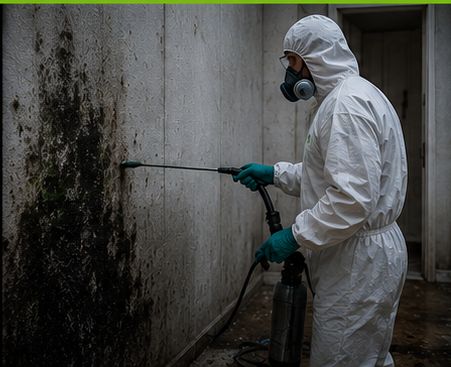
Polyethylene barriers sealed around the work area, with a negative air machine running HEPA filtration so air flows into the containment and never out of it. On larger projects this includes a decontamination chamber at the entry. Nothing gets cut until this is standing.
Protect the people in the building
HVAC serving the area is shut down and returns are sealed, so the system does not distribute spores through the house. Crews work in full protective equipment. Occupants and pets stay out of the containment for the duration.
Remove what cannot be cleaned
Porous materials that have supported growth — drywall, insulation, carpet, ceiling tile — come out and are bagged inside containment before removal. Semi-porous materials like framing can often be cleaned and treated rather than replaced.
Clean the remaining surfaces
HEPA vacuuming, damp wiping and agitation of semi-porous surfaces. The goal is physical removal of spores and hyphae — not merely killing them, because dead spores still provoke reactions and still stain.
Apply antimicrobial after the surface is dry
Treatment goes on to a dry substrate. Applying to a wet surface dilutes the product and accomplishes very little. This step supports the removal; it never substitutes for it.
Dry the space to standard
Full structural drying, because the whole problem started with moisture and will restart if any is left. Daily readings against a dry standard taken from unaffected material in the same building.
Verify, then rebuild
On an Article 32 project, post-remediation assessment is performed by the independent licensed assessor rather than by the remediator. Once it clears, we rebuild what was removed — drywall, insulation, trim, paint.
Why Long Island grows so much of it
Coastal humidity does most of the work. Summer dew points here sit high for months, and any unconditioned space — crawl space, attic, unfinished basement, detached garage — can hold surface humidity above the level mold needs for weeks at a time without a single leak.
Crawl spaces on older North Shore and East End properties are the most reliable source of calls we get. Earth floor releasing moisture continuously, almost no air exchange, fibreglass batts between the joists holding water like a sponge, and nobody looks in there from one decade to the next.
Finished basements are the second. They are near-universal across Nassau and central Suffolk, they sit in soil where the water table is close to the surface, and they are typically framed with wood and faced with paper-backed drywall — which is cellulose in direct contact with a damp foundation.
Seasonal properties on the East End are the third and worst. A house closed in November with the heat set low, a small leak somewhere, and nobody through the door until May. By the time anyone opens it the growth is not a remediation — it is a demolition.
And a specific one worth naming: much of Suffolk is still on cesspools rather than municipal sewer, so a backup delivers category 3 water directly into below-grade space. That combination of contaminated water and cellulose is the fastest colonisation we see anywhere on the Island.
What it costs, and what testing is worth
| Small area, under 10 sq ft, surface growth | $500 – $1,500 |
| Single room with containment | $1,500 – $4,000 |
| Basement or crawl space | $2,500 – $7,000 |
| Multi-room with HVAC involvement | $6,000 – $15,000+ |
| Independent assessment and clearance | $400 – $1,200 |
On testing, an honest answer: if you can see growth and you know where the water came from, air sampling frequently tells you nothing you did not already know, and it costs money that would be better spent on removal. There are no legal thresholds in New York for acceptable spore counts, so a number on a lab report has no benchmark to be measured against. Testing earns its cost when growth is suspected but not visible, when you need documentation for a sale or a dispute, or when someone in the household is ill and a physician needs information.
Get a written estimate — 516-905-5970Questions, answered
Can I just spray bleach on it?
On a hard, non-porous surface like tile or glass, bleach will clean visible growth. On the porous materials where mold actually lives — drywall, wood, grout, insulation — it performs poorly, because bleach is mostly water and the water soaks into the material while the chlorine stays on the surface. You end up adding moisture to the exact substrate that caused the problem. Dead spores also still cause reactions and still stain, so killing without removing solves less than people expect.
Does homeowners insurance cover mold?
Usually only when it results from a covered water loss and you acted promptly. A burst pipe you reported immediately, where mold followed despite reasonable steps, is often covered — though many New York policies cap mold coverage at a set dollar figure regardless of the actual cost. Mold from a slow leak, from humidity, or from a maintenance issue is nearly always excluded as preventable. This is precisely why documenting a water loss from hour one matters so much.
Is black mold more dangerous than other kinds?
"Black mold" usually refers to Stachybotrys chartarum, and it has a reputation that runs ahead of the science. Many mold species are dark in colour, and colour tells you very little about risk. What matters is that any substantial indoor growth can cause respiratory irritation and allergic reactions, and that sensitivity varies enormously between people. The remediation approach does not change based on species, so identifying it rarely changes what we do.
Do I have to move out during remediation?
For most single-room jobs, no. Containment with negative air pressure is designed specifically so the rest of the house stays usable, and the affected area is sealed off. Larger projects, work involving the HVAC system, or households with someone immunocompromised, asthmatic or pregnant are different conversations, and we would rather raise that than have you find out mid-job.
I smell something musty but I can't see anything. What now?
Trust the smell. That odour is microbial volatile organic compounds, and it usually means growth somewhere you cannot see — inside a wall cavity, under flooring, in a crawl space, or in the ductwork. We start with a moisture investigation using meters and thermal imaging rather than sampling, because finding the water is what locates the growth. This is the one scenario where testing is genuinely useful if the investigation comes up empty.
How do I stop it coming back?
Fix the water. Everything else is secondary. On Long Island that most often means grading soil away from the foundation, extending gutter discharge well clear of the house, running a dehumidifier in the basement or crawl space through the humid months, sealing a crawl space with a proper vapour barrier, and confirming bathroom and dryer vents exhaust outside rather than into an attic. Remediation without correcting the source buys you about one season.
What connects to mold work
Structural Drying
The prevention that makes remediation unnecessary. Complete dry-down inside the 48-hour window.
Drying →Flooded Basement
Below-grade damp is where most Long Island mold begins. Extraction, drying and honest cause-finding.
Basements →Sewage & Biohazard
Category 3 water plus cellulose is the fastest colonisation we see. Different containment, different rules.
Biohazard →Insurance Claim Support
Mold coverage turns on how promptly the original water loss was reported and documented.
Claims →Serving Nassau and Suffolk
Dispatching from 30 Lynch St in Huntington Station. Response times are honest by zone — 45 to 60 minutes across the core townships, longer as you head east.
Seeing growth, or smelling something?
We will find the moisture source before we quote removal, and tell you plainly whether this is a ten-square-foot job or an Article 32 project.
- 24/7 emergency line516-905-5970
- Service address30 Lynch St, Huntington Station, NY 11746
- HoursOpen 24 hours — every day of the year
- Why usCertified & experienced · Fast response · Local, trusted, Long Island proud